Drone-first room clearing uses a small unmanned aircraft system to inspect a room, passage, trench, or other confined space before personnel enter. Recent reporting from Ukraine shows FPV drones moving inside buildings and field fortifications ahead of ground forces. CQB training should therefore include indoor drone navigation, shared video interpretation, operator-team communication, and awareness of hostile drones above and inside structures.
What is drone-first room clearing?
Drone-first room clearing places a small UAS at the front of the information-gathering sequence. Its camera provides a view of spaces that may be difficult to observe from outside. Forbes documented Ukrainian FPV drones entering buildings and trench systems, showing how aircraft associated with open-air operations are increasingly being used in restricted spaces.
This footage does not establish universal doctrine, but it exposes a training gap. Drone operators may train on generic obstacle courses while ground teams conduct CQB exercises without access to an aerial camera feed. Trango’s article on drone operations training in realistic tactical environments explains why tunnels, furnished rooms, street layouts, and mixed environments belong in the same training system.
Why must CQB training integrate small UAS?
Drones value depends on integration with personnel who interpret information, make decisions, and control the physical environment.
Training facilities therefore need settings where drone operators and ground teams work from different viewpoints and compare what each can see. RUSI has also concluded that infantry training must adapt to persistent threats from above and integrate new capabilities into existing drills.
Why are modular shoot houses suitable?
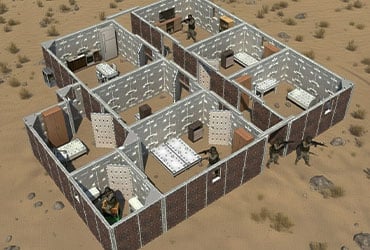
A modular shoot house provides the geometry required for indoor drone training: rooms, doors, windows, corridors, corners, and changing sightlines. Furniture and movable obstacles add visual clutter and make the camera view closer to a real interior.
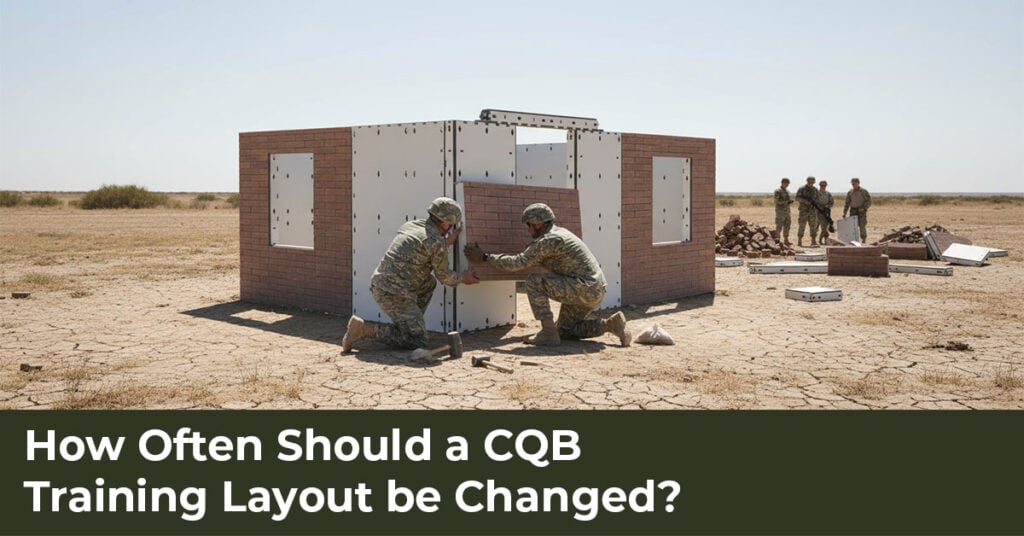
Trango shoot houses use interchangeable wall components that can be arranged into different room sequences. One wall block weighs approximately 27 lb, or 12 kg. The structures are weather-resistant and made from ricochet-free Panel-O-Foam™.
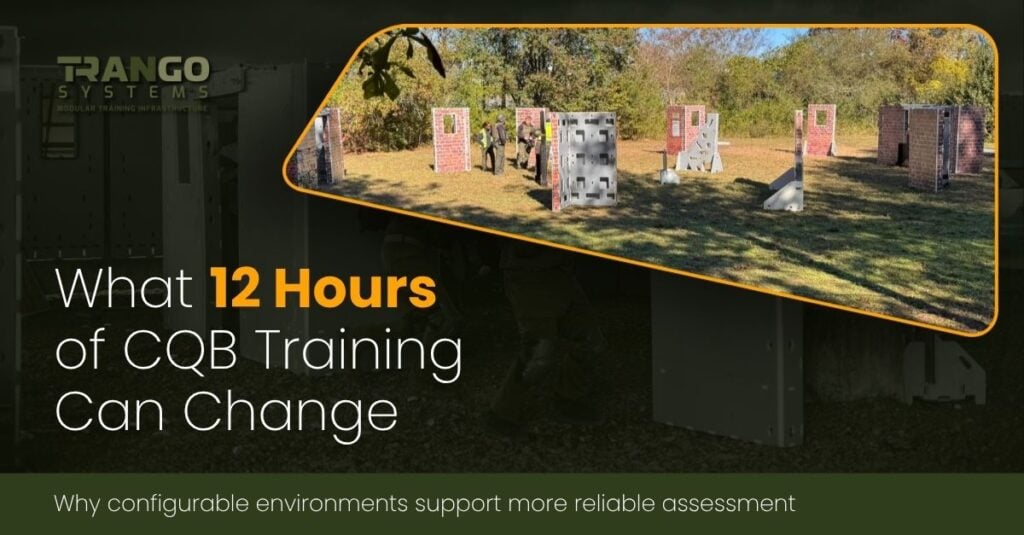
Layout changes matter because a pilot who already knows every turn and doorway is being tested partly on memory. The same applies to the ground team. Trango’s guidance on when to change a CQB training layout explains how stable layouts support instruction, while controlled reconfiguration supports adaptation and assessment.
Why do tunnels expose the hardest limitations?
Tunnels create narrow routes, repeated visual surfaces, limited reference points, junctions, and abrupt changes in direction. These conditions test orientation and camera-based interpretation in ways that open flight areas cannot reproduce.
Trango’s underground warfare training systems can form straight routes, turns, branches, and multi-path networks. Tunnel components can also connect with wall-based structures, allowing one training sequence to combine an above-ground shoot house with a confined subterranean layout.
What should a drone-ready CQB facility support?
A useful facility should allow instructors to change room and tunnel layouts, add realistic obstructions, observe the aircraft and ground team, review recorded information, and include friendly-UAS and overhead-threat awareness within established safety procedures.
Drone-first room clearing is best treated as a combined training problem. It adds another viewpoint, another information source, and another potential point of failure. Trango shoot houses and modular tunnels provide a configurable environment for testing these relationships without relying on one fixed course.
Frequently Asked Questions
-
What is the purpose of drone-first room clearing training?
It prepares drone operators and ground teams to use aerial observation inside confined spaces before personnel movement begins.
-
Can drones replace personnel in room clearing?
No. Current drones can provide observation and support, but they cannot control terrain or perform the full responsibilities of a ground force.
-
Why are modular layouts useful?
They reduce route memorization and allow instructors to change complexity, visibility, openings, obstacles, and transitions as training objectives develop.