A study published in the Journal of Police and Criminal Psychology found that 12 hours of focused Close Quarters Battle training improved overall CQB performance, with the clearest gains appearing in tactical behavior. That matters because tactical behavior is where training meets the physical environment: how a person reads a room, manages distance, uses angles, identifies danger areas and moves through limited space.
The finding supports a practical point for instructors and training managers. Short training blocks can produce measurable improvement when the environment requires trainees to solve spatial problems rather than repeat a familiar route.
Tactical Behavior Can Improve Quickly
CQB performance is often judged by visible outcomes. Was the room cleared? Was the target identified? Was the exercise completed within the required time?
Those outcomes matter, but they do not show how the trainee reached them.
The study assessed tactical behavior through danger-point recognition, use of cover, distance management and the controlled opening of angles. These skills depend on reading space correctly. A trainee must understand what can be seen, what remains hidden and how each movement changes the problem.
This is where the training environment becomes part of the method.
A simple layout may be suitable for introducing a principle. It becomes less useful when the trainee starts recognizing the route instead of analyzing the space. Improvement can then reflect familiarity with the course rather than stronger tactical judgment.
The best short-term gains are likely to come from clear objectives and repeated exposure to the same principle in different spatial conditions. The principle remains stable. The problem changes.
A Good Assessment Should Be Repeatable Without Becoming Predictable
The researchers changed the spatial arrangement between the pre-training and post-training tests to reduce memory effects. That decision has direct value for everyday CQB training.
An assessment must be repeatable so instructors can compare performance over time. The scoring criteria, safety rules and training objective should remain consistent. The route, room sequence, openings and visual conditions do not need to remain fixed.
Predictable layouts create a measurement problem. A trainee may know that a doorway appears after a specific turn or that a target is usually placed in one corner. The exercise then rewards recall.
A stronger assessment asks the trainee to apply the same tactical principles to a new configuration. The instructor can evaluate the same behaviors, but the participant must read the environment again.
This is especially relevant in refresher training. Strong performance in a familiar structure does not necessarily show that the skill will transfer when room proportions, access points or movement options change.
CQB Infrastructure Should Support Controlled Variation
The study points to a practical infrastructure requirement: the training space should be configurable enough to change the tactical problem without rebuilding the facility.
That does not mean every session requires a completely new layout. Constant change can make comparison difficult. The better approach is controlled variation.
An instructor may keep the same evaluation standard while changing one or two elements, such as the direction of entry, the number of rooms, the position of an opening, available cover or the movement sequence. These changes expose trainees to different spatial relationships while preserving a consistent objective.
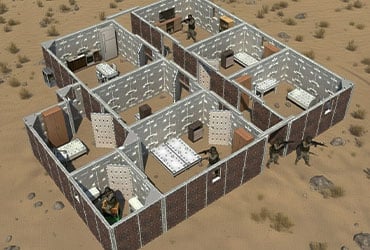
This approach also supports progressive difficulty. A basic room can introduce angle management. Later, the same principle can be tested in a longer route, a multi-room layout or an urban-style environment with competing lines of sight.
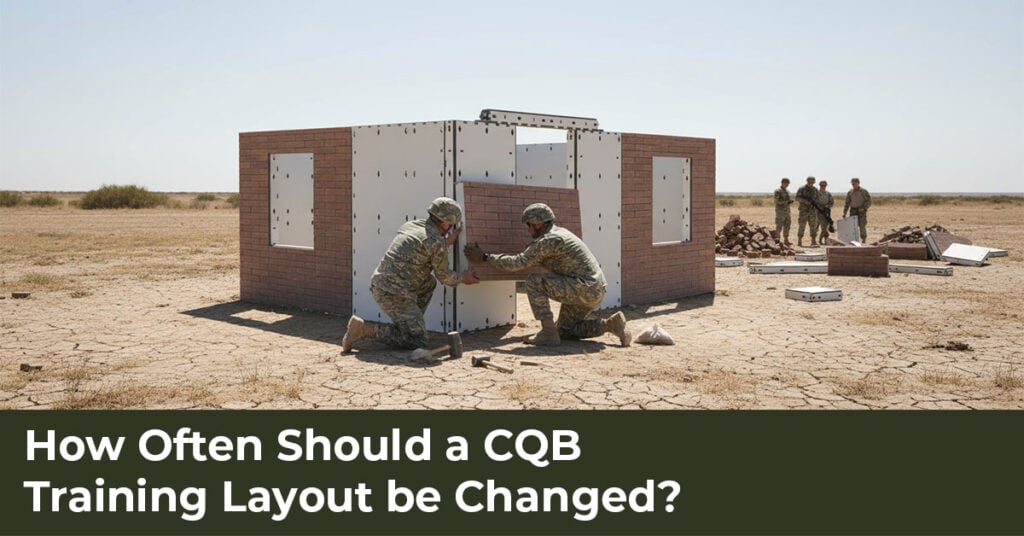
The infrastructure must make these adjustments practical. If every change requires construction work, outside contractors or long downtime, layout variation will happen less often.
What should be changed?
Reconfiguration does not always require a completely new facility plan. A few deliberate changes can alter how trainees perceive and use the environment.
Depending on the objective, instructors can modify:
- Room dimensions or proportions
- Door and window positions
- Available entry points
- Internal routes
- Intersections and corridor lengths
- Furniture placement
- Barricades and other obstacles
- Open and closed passages
- Visibility between spaces
- Target or scenario-board placement
- Starting and observation positions
The change should have a reason. Moving every wall at once can introduce so many variables that instructors cannot determine which part of the new environment affected the result.
For example, an instructor assessing recognition and decision-making might preserve the basic floor plan but change target placement, furniture, visibility, and available routes. A later exercise could use a substantially different room configuration to assess broader transfer.
Trango Systems’ modular shoot houses, CQB tracks and street environments are built for controlled variation. Instructors can change layouts, routes, rooms and access points while keeping the same training infrastructure in use.
Training can remain repeatable for assessment, yet different enough to prevent memorization.
The study shows that tactical behavior can improve in a short period when training focuses on spatial decision-making. A reconfigurable environment gives instructors more ways to test whether that improvement transfers to a new problem.
Short courses have limited time. The training space should make every repetition count.

Ricochet Free

Fully Modular

Long-Lasting

Light-weight

Cost-Effective
AND MOST OF ALL – REALISTIC