Comparing time, crew and work involved across Trango Shoot Houses, Street Environments and CQB Tracks.
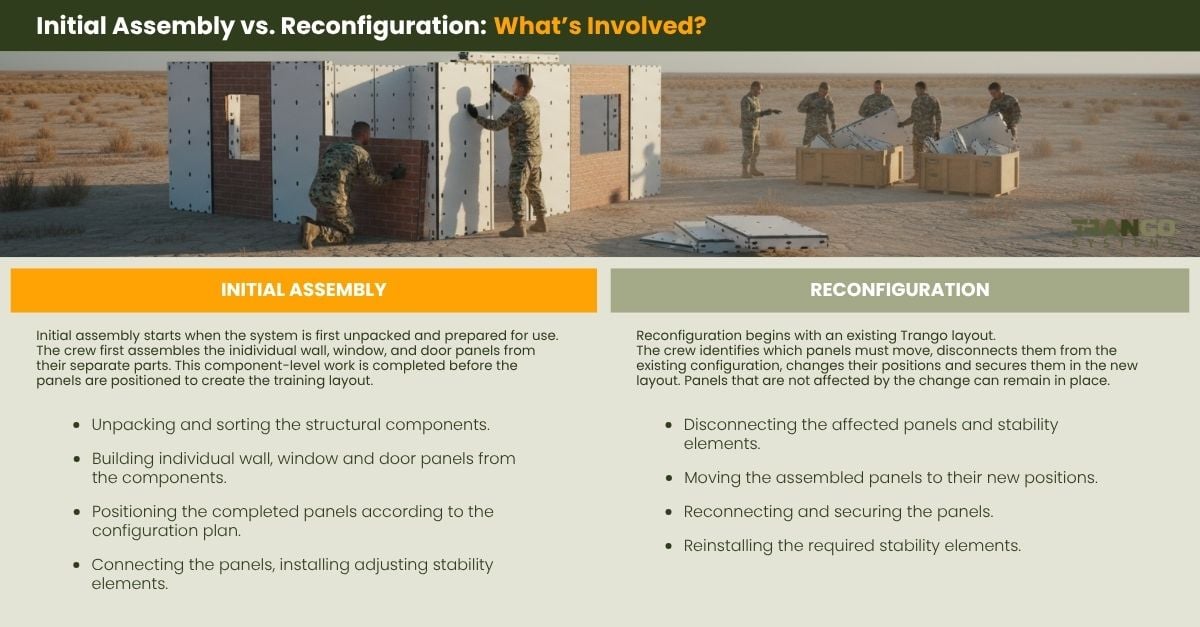
Initial assembly and routine reconfiguration are two different jobs. When a Trango system is installed for the first time, the crew builds the wall, window and door panels from their separate components. The completed panels are then positioned, connected and secured to create the first layout.
During reconfiguration, those panels are already built. The crew disconnects the panels that need to move, places them in their new positions and secures the revised structure.
Across the configurations covered here, initial assembly requires 2 to 6 people and takes from approximately 30 minutes to 8 hours. Reconfiguration takes from approximately 10 minutes to 4 hours. The exact requirement depends on the product, configuration and extent of the planned layout change.
Eric Perez and Heath Shaw from Trango USA demonstrate how to assemble the wall panels and window panels included in Trango Systems’ Package 200.
Initial assembly begins with separate components
Our Shoot Houses and Street Environments use Package 200 components and Door Packages. Our CQB Tracks use Package 100 components and barricades.
During the first installation, the crew unpacks and organizes the full contents of the selected configuration. Wall and window panels are assembled from their individual parts. Door panels are assembled where the configuration includes Door Packages.
Once the panels are ready, the crew can begin constructing the planned layout.
The work normally covers:
- Unpacking and sorting the components.
- Assembling the wall and window panels.
- Assembling the door panels where required.
- Positioning the completed panels.
- Connecting the panels and installing the beams and stability elements.
The Components and Basic Kits page shows the Package 100, Package 200, Door Package and stability components used across these systems.
Our wall and window assembly video shows the component-level work involved in preparing the panels. The visual Assembly Guide provides instructions for the structural components and stability elements.
Reconfiguration uses panels that are already built
A layout change begins with an assembled structure. There is no need to rebuild each panel from its individual parts.
The crew reviews the new layout and identifies the panels that must move. Unaffected parts of the structure can remain in place.
The work normally covers:
- Disconnecting the affected panels and stability elements.
- Moving the assembled wall, window or door panels.
- Reconnecting and securing the panels in their new positions.
- Reinstalling the required stability elements.
A minor change may involve one door, opening or route. A complete reconfiguration may change most of the floor plan. The time required will vary accordingly.
Layout changes should follow the training plan rather than a fixed calendar. Our article How Often Should a CQB Training Layout Be Changed? explains when instructors may benefit from retaining a familiar layout, introducing selected changes or building a substantially different configuration.
What's involved in Shoot House assembly and reconfiguration
Trango modular Shoot Houses are available in five configurations: Basic, Advanced, Expert, Pro and Pro+. Each configuration contains a different quantity of Package 200 and Door Packages. Depending on these amounts, the following initial assembly and reconfiguration times are expected:
Scroll sideways to see all configurations →
The Basic, Advanced and Expert configurations can be assembled and reconfigured by crews of 2 to 4 people. The larger Pro and Pro+ structures require 4 to 6 people.
Initial assembly time increases with the quantity of panels, doors, connectors and stability elements included in the configuration. Reconfiguration time depends on the size of the existing structure and how much of its layout will change.
Street Environments assembly and reconfiguration requirements
Scroll sideways to see all configurations →
Trango Street Environments create open urban layouts for team movement, positioning, angle management and scenario-based training.
Basic and Advanced use Package 200 components. Expert adds a Door Package.
CQB Training Tracks assembly and reconfiguration requirements
Scroll sideways to see all configurations →
Trango CQB Tracks use Package 100 components and barricades to create defined lanes for close-range movement, angle and engagement drills.
Reading the time estimates correctly
The tables show approximate structural assembly and reconfiguration times.
Initial assembly covers:
- Organizing the structural components
- Building the wall and window panels from separate elements
- Building door panels where included
- Constructing and securing the first layout
Reconfiguration covers:
- Disconnecting the parts of the existing layout that must move
- Repositioning assembled panels
- Reconnecting and securing the revised structure
Delivery, unloading and moving the packages from storage should be planned separately. The figures also exclude the placement of targets, furniture and other training accessories, as well as any inspection or approval procedure required by the facility.
The listed reconfiguration times are planning estimates. Moving one opening does not require the same amount of work as changing most of a Pro+ Shoot House. The proposed layout should therefore be considered when scheduling the crew.
Frequently Asked Questions
-
Is initial assembly included in the reconfiguration time?
No. Initial assembly starts with separate components and includes building the panels. Reconfiguration starts with an existing structure and assembled panels.
-
Are panels taken apart when the layout changes?
No. During normal reconfiguration, completed wall, window and door panels are moved and secured in new positions.
-
Does every reconfiguration involve the complete structure?
No. Panels that are unaffected by the new layout can remain in place. The crew only needs to disconnect and move the sections required for the planned change.
-
Do Trango systems require construction tools?
No specialized construction tools or lifting machinery are required for structural assembly or routine reconfiguration. Delivery and unloading requirements should be confirmed separately for the selected configuration.