You buy a video game everyone raves about. It has stunning graphics, tight controls, and clever level design. You love it at first. But here’s the problem: it only has one level.
After your tenth playthrough, you know every enemy placement. You memorize where the boss pauses for exactly two seconds. The optimal route becomes automatic. That challenge? Gone. The game collects dust while you search for something new.
This scenario plays out daily in training facilities across the country. But nobody talks about it.
The Static Facility Problem
Concrete shoot houses cost half a million dollars or more. They look impressive. They’re “permanent.” Law enforcement agencies build them with the assumption that durability equals value.
Then officers train in them. And train in them. And train in them again.
After a few runs, the hallway layout is memorized. Officers stop reacting to threats. Instead, they move through familiar spaces on muscle memory. The corner they clear? They already know what’s there. The door they breach? They’ve breached it a hundred times in exactly the same spot.
The training scenario becomes a habit. Not a test. Not a challenge. Just something they run through.
The Math of Wasted Potential
| The numbers presented here are approximate examples. Actual prices for static and modular training facilities vary considerably based on location, materials, specifications, and vendor. This comparison is illustrative and should not be regarded as actual costs. |
Here’s where the numbers get uncomfortable.
A static concrete facility costs $500,000. It offers one fixed layout. That means each training scenario costs $500,000.
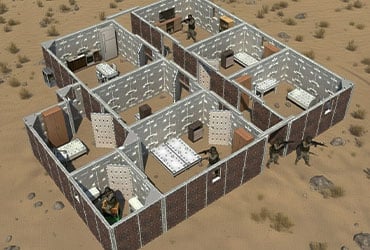
A modular system costs $100,000. But this same investment can reconfigure into 100 different layouts. A school hallway. A residential apartment. An open-plan office. Each unique environment that officers actually encounter in their jurisdiction.
Now the math changes: $100,000 divided by 100 layouts equals $1,000 per scenario.
That’s a 500x difference in training value.
The concrete building has a longer physical lifespan. It will stand for decades. But its training value starts high and crashes hard within weeks.
Variety and Speed Change Everything
Modular environments offer almost endless variety. This is critical, but they also offer speed, which is not less important.
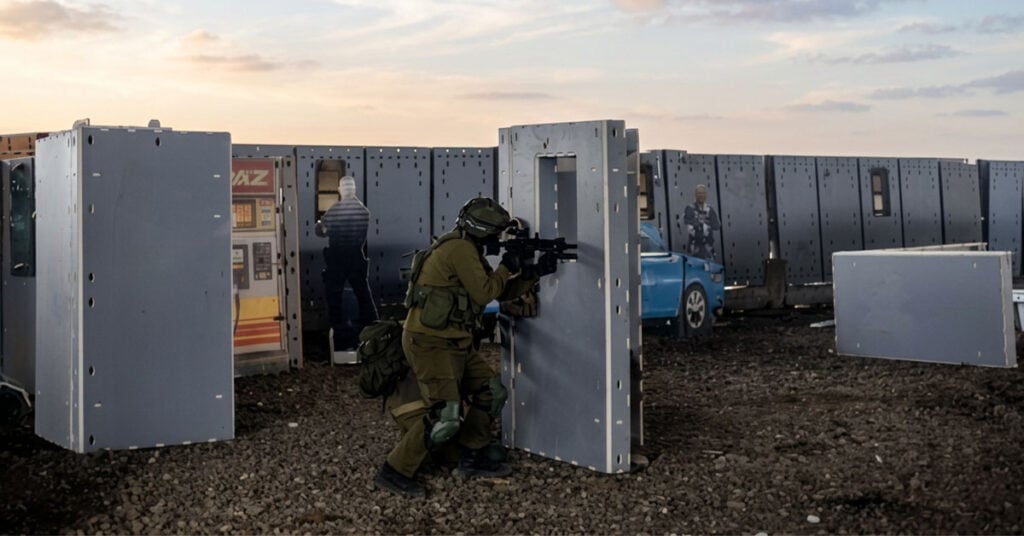
A team of two or three people can completely reconfigure a room in a matter of minutes. This matters because instructors can change the layout while officers are reloading or debriefing. By the time the next team enters, the “problem” is completely different.
No memorization works. No shortcuts exist. Officers face a fresh environment every single session.
This continuous novelty is what keeps training sharp. The same way a video game with a level editor stays engaging long after the original campaign ends.
Environmental Replication Without Limits
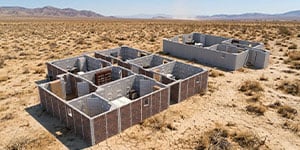
Modular walls do something static facilities cannot. They replicate real environments.
The facility becomes a capability, not a building. It transforms into whatever your officers need to train for, whenever they need to train.
Static facilities force compromise. You build one layout and hope it covers most scenarios. Modular systems eliminate that guesswork.
Your jurisdiction has specific mall layouts? Build it. Residential apartments with unusual door placements? Build it. Commercial office buildings with multiple exits? Build it.

The Real ROI Question
When an agency evaluates a training facility, the decision usually centers on upfront cost and expected lifespan.
It should center on something else: how many unique tactical problems can this facility present per dollar spent?
A $500,000 facility with one layout? One problem.
A $100,000 system with unlimited reconfiguration? Infinite problems.
The choice looks different when you measure it this way.
Commonly asked questions
How long does it take to change a modular layout?
A small team of 2-4 people can reconfigure an entire layout in minutes. Under 10 minutes for smaller facilities, 10-30 minutes for large setups.
Do modular systems degrade fast?
Quality modular systems are designed for repeated reconfiguration and long-term durability. They can serve for many years, and if one section fails (in a few years), you can simply replace it. No major repairments or investments are needed.
Can I keep my modular system outside?
Yes, at least this is the case with Trango Systems. You can keep it outside, it’s weather-resistant, be it rain, snow, extreme temperatures, or UV radiation.
At Trango Systems, we design training infrastructure that moves with your mission. Our modular mobile solutions give teams the flexibility to deploy, adapt, and train anywhere — without the logistical burden of traditional builds. Whether for CQB, tactical movement, or live scenario preparation, our systems deliver the realism, durability, and mobility that modern forces demand. Contact Trango Systems to transform the way your team trains.