Barricades are one of the simplest ways to add structure, realism, and variation to a CQB training environment. They turn open space into a more complex setting by creating physical barriers, partial openings, visual interruptions, and changing spatial conditions.
In close-quarters training, the environment matters. Empty lanes and open rooms have limited training value. A useful training space needs obstacles, boundaries, depth, entries, exits, furniture, targets, and scenario logic. Barricades help create those conditions without permanent construction.
A barricade is not only an obstacle. In a well-designed training environment, it becomes part of the layout. It helps instructors shape space, adjust complexity, and create more realistic conditions for military, law enforcement, and professional security training.
Barricades as training infrastructure
A barricade should not be treated as a random object placed in a range.
In CQB training, it is part of the infrastructure. It helps define the space, shape the scenario, and create physical conditions that affect how the layout works.
A well-planned barricade setup can support several training requirements:
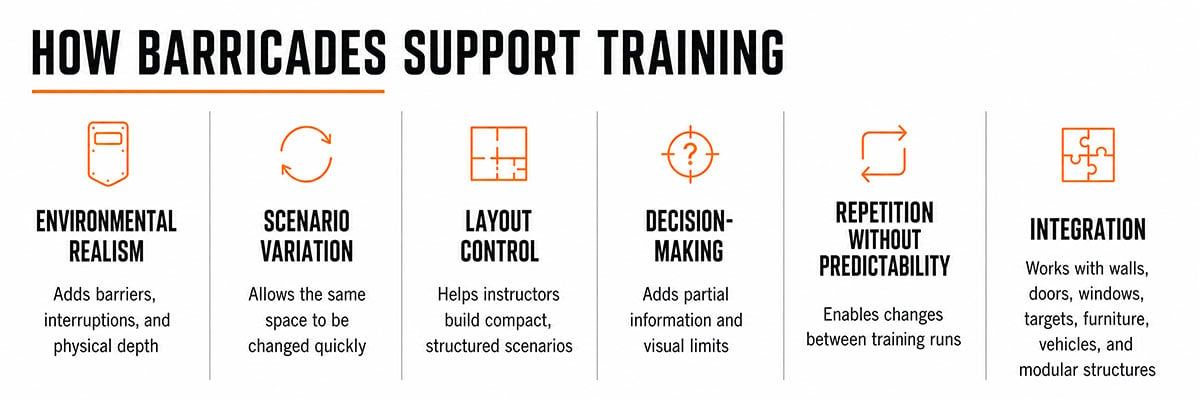
This is especially important in modular training environments, where the same physical area may need to support different scenarios over time.
What is a barricade in a CQB training environment?
In a CQB training environment, a barricade is a physical training element used to shape space. It may represent a barrier, a partial wall, a blocked opening, an obstacle, or another environmental feature.
Its value comes from what it changes inside the training area.
A barricade can:
- break up an open space
- create partial visibility
- add physical depth
- form temporary boundaries
- introduce controlled complexity
- make layouts less predictable
- support scenario-based training
For CQB environments, barricades should be understood as part of the training infrastructure. They are not only range accessories. They help create the physical conditions that make a training layout more useful.
Why barricades matter in CQB training
CQB training depends on controlled complexity. The training space should be safe, manageable, and repeatable, but it should not be empty or predictable.
Barricades allow instructors to change how the space is read, how much of the environment is visible, and how trainees experience movement through the layout. This supports training that involves observation, communication, judgment, and controlled decision-making.
Police training research has also emphasized the need for decision-making, communication, critical thinking, and scenario-based learning in modern law enforcement training. A Police Executive Research Forum report noted that recruit training in the United States often gives insufficient attention to decision-making and communication skills used every day.
The role of barricades in modular CQB layouts
A modular CQB layout should be easy to change. If the layout remains the same for too long, trainees can begin to memorize the environment instead of reading it.
Barricades can be added, removed, rotated, or combined with other elements to create new layouts. A barricade can add variation inside a compact track, add internal complexity to a room-based environment, or help define a temporary obstacle in a larger training area.
This is where barricades become more than accessories. They become part of the system that allows instructors to refresh the training environment without rebuilding the whole facility.
What makes a barricade useful for CQB environments
A barricade used in a CQB environment should be evaluated by practical criteria. Its value depends on how well it supports layout design, safety, durability, portability, and repeated use.
Repositioning
CQB environments often need frequent layout changes. A barricade that is difficult to move becomes a fixed obstacle. A barricade that is easy to move becomes a reusable training tool.
Portability matters because instructors need to change the training space without losing too much time between scenarios.
Stability
A barricade must stand reliably during training use. Stability is important for safety, consistency, and repeatability.
A barricade that moves unexpectedly, leans, or requires improvised support can interrupt training and create avoidable risk. Purpose-built legs, support systems, or stable base structures help make barricades more practical for repeated training use.
Physical Depth
Very thin barriers may be easy to store, but they do not always create the same spatial effect as a realistic structure.
Depth changes how a barricade feels inside the environment. It affects openings, edges, partial barriers, and the way the object shapes the layout.
More importantly, it changes the shooting angles and weapon handling.
For CQB environments, thickness can matter as much as height and width. A barricade with real physical depth is more useful than a flat symbolic marker.
Material Behavior
Material selection is central to safety and durability.
A barricade used in a professional training environment should be suitable for the intended training method. The material should match the required level of use, expected exposure, storage conditions, transport needs, and safety requirements.
For outdoor or semi-outdoor training areas, weather resistance also matters. Equipment that warps, absorbs water, breaks easily, or requires frequent replacement creates extra cost and downtime.
Compatability
A barricade is most useful when it works with the rest of the training environment.
It should fit naturally with walls, doors, windows, targets, furniture, vehicles, and other scenario elements. In a modular environment, compatibility is what turns separate pieces of equipment into a coherent training system.
Hole patterns, barricade size, and training realism
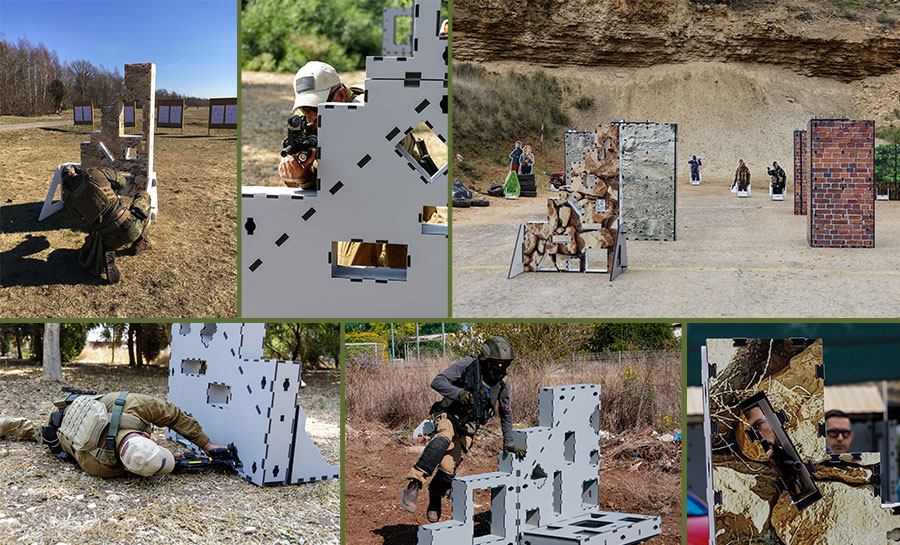
The shape and placement of openings are central to how a barricade functions in a CQB training environment.
A flat barrier with one standard opening creates limited variation. A barricade with multiple openings at different heights, widths, and shapes gives instructors more flexibility when building scenarios.
Different hole patterns can support:
- varied body positions
- different viewing heights
- different working angles
- low, mid, and higher openings
- more realistic use of partial structures
- scenario variation without changing the entire layout
Size also matters. A barricade must be large enough to create a real physical obstacle, not just a symbolic marker. It should have enough width and height to affect the layout of the training space, while still being movable enough for regular reconfiguration.

Practical Barricade Selection Criteria
For procurement, a barricade should be evaluated by how it performs in daily training use.
A barricade should be evaluated by function, durability, flexibility, and long-term cost. It needs to work across repeated training runs and integrate with the surrounding training setup.

Barricades and scenario design
Barricades are valuable because they allow instructors to design different scenarios without changing the entire facility.
They can help create:
- temporary room-like divisions
- interrupted sightlines
- constrained passages
- layered spaces
- partial visual obstruction
- compact CQB layouts
- more realistic visual clutter
- scenario-specific boundaries
This supports the same broader principle behind scenario-based training: the training environment should require recognition, judgment, and decision-making, not only mechanical repetition.
Barricades, cover, concealment, and precise use
In training environments, barricades may represent different physical conditions. Depending on the scenario and the training method, a barricade may simulate a barrier, a partial obstruction, a blocked opening, a structural edge, or a piece of environmental clutter.
The words “cover” and “concealment” should be used carefully because they do not mean the same thing. Whether a barricade represents one or the other depends on the scenario, the material, and the training method.
For general CQB training infrastructure, the safest and most accurate way to describe barricades is this:
Barricades help simulate physical barriers, partial openings, and visual obstructions inside controlled CQB training environments.
That definition keeps the focus on the environment rather than on tactical instruction.
Stand-alone barricades vs. integrated barricades
Barricades can be used in two main ways.
Stand-alone barricades
A stand-alone barricade can add one physical element to an otherwise open area. This may be useful when the training objective requires a single obstacle, a short setup, or a compact layout.
Stand-alone barricades are also useful when a training team needs a simple way to add variety to a familiar range.
Integrated barricades
Integrated barricades are part of a larger environment. They work with walls, doors, windows, targets, vehicles, furniture, and other training elements.
For CQB training, the integrated approach usually provides greater value. It allows the barricade to become part of a realistic setting rather than a single isolated object.
Barricades in different CQB training environments
Barricades can support several types of training infrastructure.
Room-based layouts
In room-based layouts, barricades can add internal variation, divide space, and create partial obstructions. This is useful when the same room or structure needs to support multiple training scenarios.
Track-based layouts
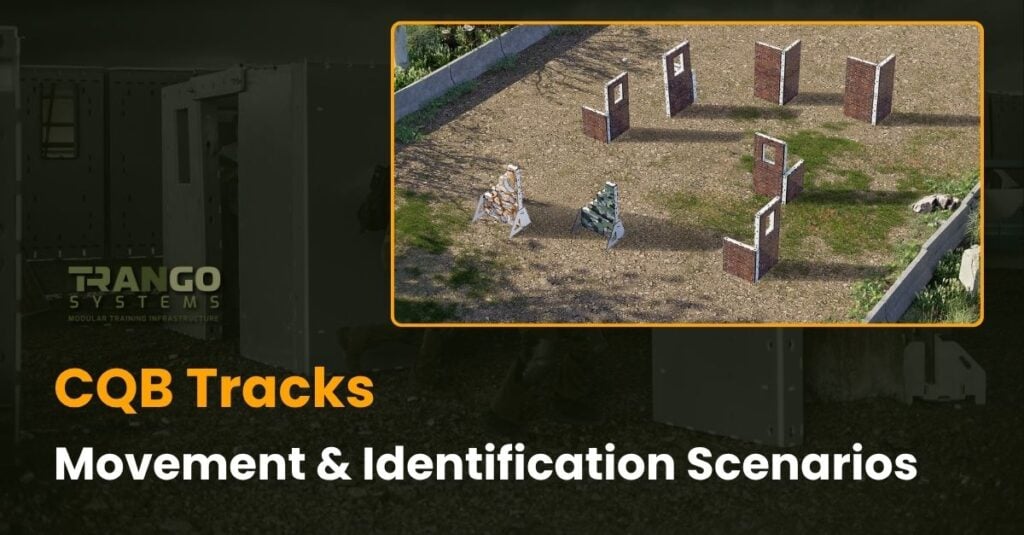
In compact CQB tracks, barricades can change the feel of the lane, add spatial variation, and reduce predictability.
Street-style layouts
In street-style environments, barricades can help define temporary obstacles, scene boundaries, and added visual complexity.
Scenario-based layouts
In scenario-based environments, barricades can work with targets, furniture, vehicles, and other visual elements to create a more complete training scene.
The strongest results usually come from using barricades as part of a system, not as separate objects.

What agencies usually specify when requesting CQB barricades
When military, law enforcement, or training agencies prepare a product inquiry for barricades, they often describe the requirement in functional terms rather than brand terms.
The inquiry may ask for modular barricades suitable for CQB training environments, with defined dimensions, stable free-standing use, portability, repeated repositioning, compatibility with scenario-based layouts, and material behavior appropriate for the intended training method.
A practical requirement paragraph may look like this:
The barricades should be modular, portable, stable during use, and suitable for integration into CQB training environments, room-based structures, tactical tracks, and scenario-based layouts. They should support varied training positions through openings at different heights and shapes, allow frequent repositioning, and be suitable for indoor or outdoor use. The barricades should be durable, lightweight enough for regular setup changes, and compatible with the safety requirements of the training method used by the agency.
This type of paragraph is useful because many buyers build RFQs and product inquiries around functional requirements. It helps define what the barricade must do, not only what it is called.
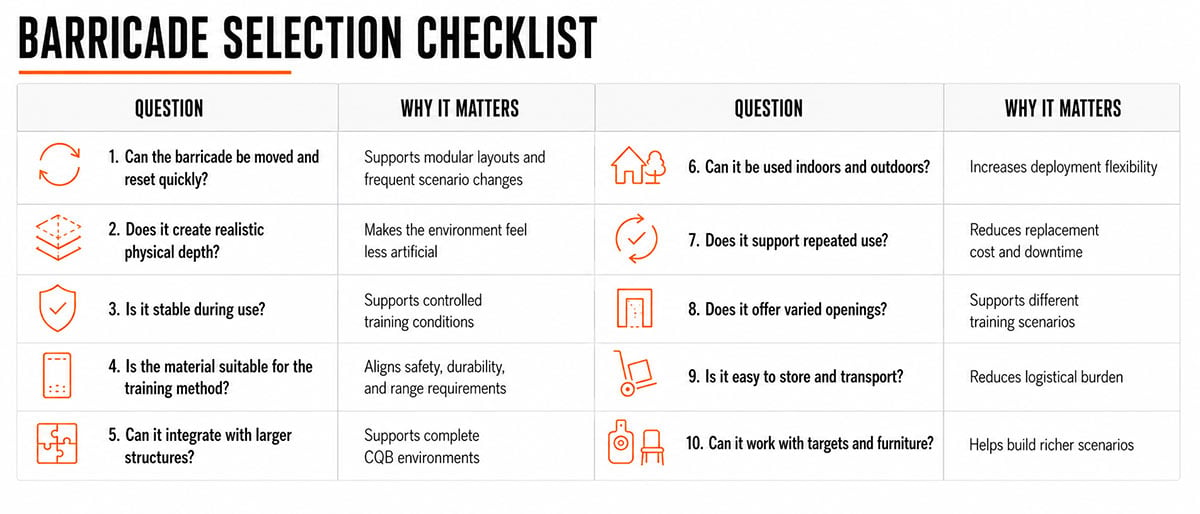
Barricade Selection Checklist
When choosing barricades for a CQB training environment, agencies and training facilities should consider the following questions:
Barricades and procurement value
For procurement teams, barricades should be evaluated not only by unit price.
The better question is how much training value the barricade provides over time.
A low-cost barricade that is difficult to move, unstable, or unsuitable for repeated use may become expensive over time. A more practical barricade should reduce setup time, support multiple scenarios, and integrate with the larger training environment.

Trango Systems’ modular barricades are built from Panel-O-Foam™, a proprietary composite used across the company’s modular training infrastructure. Each barricade measures 120 x 180 x 15 cm, or 48 x 72 x 6 inches, and weighs about 14 kg, or 30 lb. The 15 cm, or 6 inch, thickness gives the barricade physical depth, while the lightweight structure supports frequent repositioning. The barricades are foldable, supplied with two Barri-Legs for stability, and designed for integration with broader CQB environments, including tracks, shoot houses, and street-style training layouts.