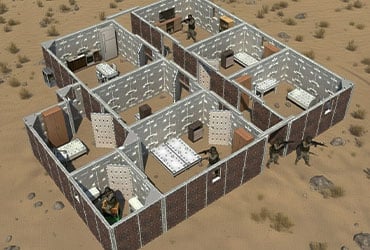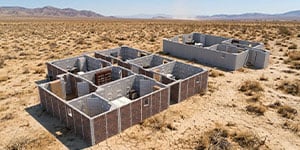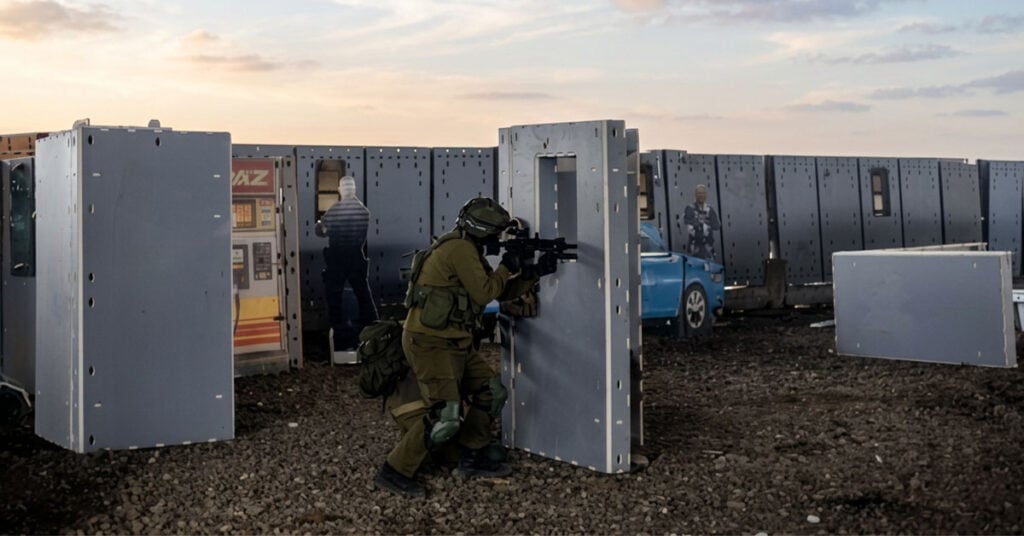
Furniture is essential for realistic Close Quarters Battle (CQB) training because it breaks up sightlines, creates additional “dead space” (hiding spots), and forces operators to navigate physical obstacles. This replicates real-world conditions where threats use cover and concealment.
What happens when your Shoot House is empty?
You kick the door. You flood the room. You sweep your corners. The room is clear.
But was it really a room? Or was it just a box?
For decades, Close Quarters Battle (CQB) training has relied on “shoot houses” that bear little resemblance to actual houses. They are sterile environments—square rooms with bare plywood or rubber walls, devoid of life’s clutter.
This creates the “Empty Room” Fallacy. It is the dangerous assumption that if an operator can clear an empty 12×12 foot box, they can clear a living room, an office, or a hoarder’s den.
This assumption is false. And in a high-threat environment, it gets people killed.
Real-world violence does not happen in a vacuum. It happens in kitchens, bedrooms, and cluttered offices. By training in sterile environments, we are not just missing an opportunity for realism; we are building dangerous “training scars.”
Here is why tactical furniture is not just set dressing: it is a fundamental requirement for validating TTPs (Tactics, Techniques, and Procedures).
The Cognitive Load: Target Discrimination in Chaos
In a sterile shoot house, target identification is binary. The brain processes the environment instantly.
-
See Wall.
-
See Floor.
-
See Target.
-
Engage.

There is no visual noise. The “signal-to-noise” ratio is incredibly high.
Now, add a couch, a overturned table, a coat rack, and a television. The operator’s OODA Loop (Observe, Orient, Decide, Act) faces immediate friction. The brain must now filter out harmless shapes to identify the threat.
The “Coat Rack” Effect
A classic example in law enforcement shootings is the misidentification of common objects as threats in low-light conditions. A silhouette by a window might be a suspect, or it might be a floor lamp.
If operators never train their eyes to scan through and around common household objects, they fail to develop the rapid visual processing speed required for real-world raids. Furniture forces the operator to process depth and shape, not just color and movement.
Training Scars: The Path of Least Resistance
What is a Training Scar? A training scar is a bad habit ingrained during practice that manifests involuntarily under stress.
In an empty room, operators tend to take the most direct path to their Point of Domination (POD). They drive hard into the corner, collapsing their sector. It looks fast. It looks aggressive.
But place a dining table in the center of that room, and that “fast” entry becomes a disaster.
The Footwork Problem
If an operator is used to sprinting to a corner, and suddenly there is a heavy ottoman in the way, two things happen:
-
They trip. This takes them out of the fight and flags their teammates with their muzzle.
-
They fixate on the obstacle. Their eyes drop to the floor to navigate the furniture, meaning they are no longer scanning for threats.
Tactical Reality: Trango’s modular furniture kits force operators to adjust their speed and footwork dynamically. You cannot “game” the room if the layout of the obstacles changes every run.
Dead Space: Where the Threat Actually Lives
In a sterile room, “dead space” (areas you cannot see from the door) is usually limited to the hard corners.
In a furnished room, dead space is everywhere: under the bed, behind the sofa or the kitchen island.
A suspect hiding behind a cupboard is invisible to an operator standing in the doorway. This forces the operator to ‘slice the pie’ not just on the door frame, but on the objects inside the room.
Key Takeaway: if you aren’t clearing behind the furniture, you aren’t clearing the room. You are just walking through it.
Ballistics and Material Safety in Training
One reason facilities avoid furniture is safety. Bringing a real wooden cabinet or a steel refrigerator into a shoot house is a logistical nightmare and a safety hazard.
-
Ricochets: Steel appliances can send rounds back at the stack.
-
Splinters: Wood furniture creates secondary fragmentation when hit.
-
Durability: A real couch is destroyed after a few simulation rounds.
This is where purpose-built training equipment bridges the gap. Systems like Trango’s furniture kits are designed specifically for this environment. They mimic the dimensions of real furniture but are constructed from ricochet-free materials.
This allows instructors to create “hard” obstacles that can be shot safely at close range. It eliminates the safety excuse for running empty rooms.
Practical Application: 3 Drills to Break the “Empty Room” Habit
Stop running “drag races” to the corner. Implement these three concepts using modular furniture to force thinking over speed.
Drill A: The Deep Threat (Limited Penetration)
Setup: Place a large sofa or overturned table facing the entry door, about 3 meters back. Place a threat target prone behind it, visible only from a specific deep angle. Objective: The operator must execute a limited penetration (LimPen) or “pie” the door fully to see the threat. Failure Point: If the operator enters too fast (dynamic entry) without clearing the center, they will be exposed to the prone target before they can identify it.
Drill B: The “Fatal Funnel” Obstruction
Setup: Place a low obstacle (coffee table or crate) directly in the path of the #1 man’s primary route to the corner. Objective: The operator must recognize the blockage while in the doorway and instinctively reroute or step over without dropping their eyes or muzzle. Failure Point: Tripping, looking down, or stopping in the doorway (the fatal funnel).
Drill C: The Vertical Scan
Setup: Use a “kitchen counter” or “bar.” Place targets at varying heights: one standing behind it, one kneeling, and one prone. Objective: Force the operator to change their focal plane. Most shooters train to shoot at chest height. This drill forces engagement at different elevations.
Common Questions on Using Furniture for Tactical Training
Can we use tires or plywood for firniture?
It is not recommended for live fire (needs confirmation on specific range regulations). Tires can cause unpredictable ricochets and capture rounds, creating a fire hazard. Plywood creates secondary fragmentation (splinters) when hit. Purpose-built composite or foam furniture is safer for close-range work.
How often should we change the furniture layout?
Ideally, every few runs. If an operator knows the couch is on the left, they stop processing information. Trango’s modular kits are designed to be moved by one person, allowing for rapid changes between teams.
Does furniture change the safe standoff distance?
With standard steel or wood, yes. With Trango’s non-ricochet materials, you can generally maintain close-quarters engagement distances.
At Trango Systems, we design training infrastructure that moves with your mission. Our modular mobile solutions give teams the flexibility to deploy, adapt, and train anywhere — without the logistical burden of traditional builds. Whether for CQB, tactical movement, or live scenario preparation, our systems deliver the realism, durability, and mobility that modern forces demand. Contact Trango Systems to transform the way your team trains.