You’re not buying square footage, you’re building capability. The most resilient facilities put safety, adaptability, and training throughput at the center, then select materials, targets, and layouts that support those outcomes.
What is Training Facility Design?
Before sketching walls, define the capabilities your facility must produce in trainees. Common outcomes include:
- CQB fundamentals: entry sequencing, corner work, hallway intersections.
- Judgment & PID: friend/foe discrimination, low‑light identification.
- Team communication under stress: clear calls, cross‑coverage, deconfliction.
- Confined‑space skills: tunnels, basements, and tight turns.
Design rule: Lock outcomes, then specify layout types, target mix, live‑fire vs NLTA (Non-Lethal Training Ammunition), observation, and a weekly reconfiguration cadence.
Safety by Design (make it hard to get wrong)
A facility should enforce safe behavior and reduce risk by design.
- Control ricochets: Use safe materials and layouts that stop bullets and prevent bounce-backs.
- Easy exit and medical access: Every room should have a clear way out and quick access for medical help.
- Clear rules and oversight: Keep live ammo separate from training rounds, post clear signs, require protective gear, and ensure instructors can always watch and guide.
Modular vs. Permanent: Which Approach Fits?
Modular (Composite) Systems
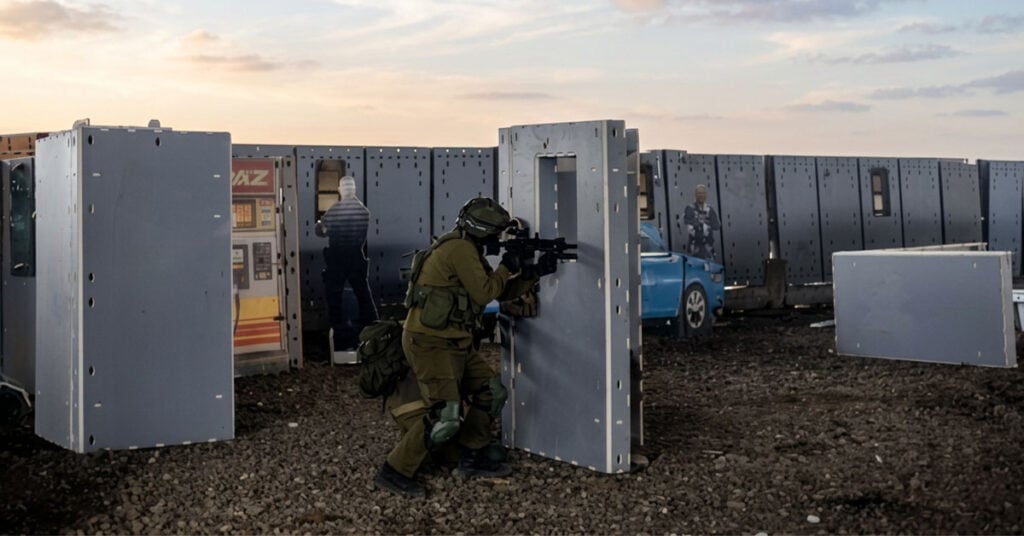
- Reconfigurable in minutes or hours; prevents layout memorization.
- Lightweight & deployable; many elements installable by small teams.
- Phaseable—start lean, expand as doctrine evolves.
Pairs well with CQB tracks, moving targets, and friend/foe scenarios.
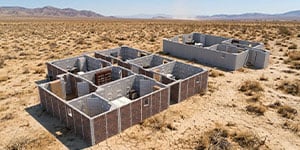
Permanent/Heavy Builds (Steel/Rubber/Concrete)
- Fixed capacity and infrastructure‑intense (ventilation, baffles) for high‑volume live‑fire.
- Ideal when layouts rarely change and long‑term permanence is required.
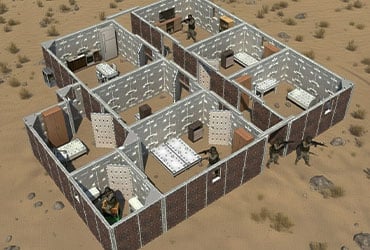
Pragmatic answer: many organizations start modular and later add a permanent live‑fire wing or hybridize. Explore Mobile Modular Shoot House as starting point. Combination with life-like training accessories is advised for greater realism.
Modular Shoot House may be a great alternative for permanent structures. But make sure it’s stable, durable, and weather-resistant (if you intend using it for outdoors training and move from one location to another).
Explore Modular Shoot House
Space Planning That Mirrors Doctrine
Build zones that reflect how teams actually move and fight:
- Entry/Breach zone: multiple door/window types and transitional corners.
- Hallways & intersections: force cross‑coverage and comms protocols.
- Room variety: single rooms, L‑rooms, multi‑room suites.
- Observation: catwalks or camera rigs for instructor POV.
- Admin & staging: briefing, cleaning, brass capture, ammo control.
Reconfigure weekly to keep cognition fresh.
CQB Tracks: Micro-Skills at Scale
Short, reconfigurable lanes deliver high reps without monopolizing the house. Rotate weekly to defeat pattern learning. Track split times, verbal clarity, coverage errors, and target ID accuracy.
Learn more about CQB Tactical Training Tracks.
Confined-Space / Tunnel Training Modules
If your mission includes basements, subways, or tunnels, dedicate confined‑space modules. Plan egress routes, instructor shadow lines, comms tests, and lighting variations; simulate degraded environments and incorporate rescue lanes.
Explore Subterranean Training Infrastructure for modular tunnel kits.
Tunnel infrastructure may be tricky to build, especially in any permanent configurations. Modular tunnel systems that imitate underground settings and may be reconfigured for diverse training scenarios, is an excellent alternative.
Targets that Teach Decisions, not just Accuracy
Upgrade cognition with a smart target mix:
- Friend & Foe targets for PID and shoot/no‑shoot discipline.
- Moving targets to compress OODA loops and timing.
- 3D vehicles and range accessories for angles, cover, and realistic constraints.
Assembly, Reconfiguration, and Maintenance
Training time is precious: minimize downtime with tooling‑light systems and clear documentation. Two‑to‑four‑person teams should safely reconfigure common elements. Schedule preventive maintenance monthly; perform a deeper inspection quarterly.
Phasing your Roadmap (Budget-Smart)
Phase 1: Modular core + CQB tracks + friend/foe targets.
Phase 2: Add moving targets, vehicles, and observation features.
Phase 3: Introduce confined‑space modules or a live‑fire wing.
Your Next Step
Share your mission set, space constraints, and training goals. We’ll return a modular layout fits your needs.
Explore Modular Shoot Houses, CQB Tracks, Moving Targets, and Subterranean Modules.
For quotes, Find a Distributor in your region or fill out the form.
Frequently Asked Questions
-
What is training facility design?
It aligns learning outcomes - CQB decision‑making, marksmanship, communication - with physical elements like layouts, materials, targets, and safety systems to produce repeatable, measurable capability.
-
Should I choose modular or permanent construction?
Choose modular if you need rapid reconfiguration, portability, and phased budgets. Opt for permanent (or a hybrid campus) if you run fixed layouts at high live‑fire volume with long‑term infrastructure.
-
How often should I reconfigure a modular shoot house?
A weekly reconfiguration cadence keeps scenarios fresh and prevents layout memorization; rotate doors, windows, and intersections at a minimum.
-
What target types improve decision‑making?
Use friend/foe targets to train PID (Positive Identification)—the ability to quickly recognize and confirm whether a target is a threat or not. Add moving targets to put pressure on the OODA loop (Observe, Orient, Decide, Act), forcing trainees to think and act faster under changing conditions. Incorporate 3D props or vehicle targets to create realistic angles, cover, and constraints that mirror real-world environments.
-
Can tunnel or underground training be modular?
Yes. There are tunnel models, that imitate subterranean infrastructure and support confined‑space drills without permanent excavation. Ensure safety protocols.