A modular shoot house can cost anywhere from about $2,500 for a cardboard layout to hundreds of thousands of dollars for a large reusable system. The component list sets the price, not the footprint: the number of wall sections, how many doors and windows are working assemblies, the wall material, and the ammunition the walls must take.
What makes up modular shoot house cost
Every quotation is a list of parts. These are the lines that move the total.
| Cost item | What drives the price | What to check in the quote |
|---|---|---|
| Wall sections | Number of walls, height and length. A layout split into small rooms needs far more walls than an open one of the same area. | Is a “panel” a complete wall section or only a facing sheet? |
| Doors | An open doorway costs little. A working door adds a frame, hinges, a latch and the door leaf. | How many doorways are working doors, and which type? |
| Windows | Same as doors: an opening, or a window with a frame and shutter. | Openings or full window assemblies? |
| Connectors and supports | Posts, bases, brackets and corner pieces. Every junction needs them. | Are all connectors for the drawn layout included, or quoted separately? |
| Extra and spare parts | Parts for other layouts, future expansion and replacement after wear. | Which spares are included, and can they be ordered one by one? |
Same floor area, different price
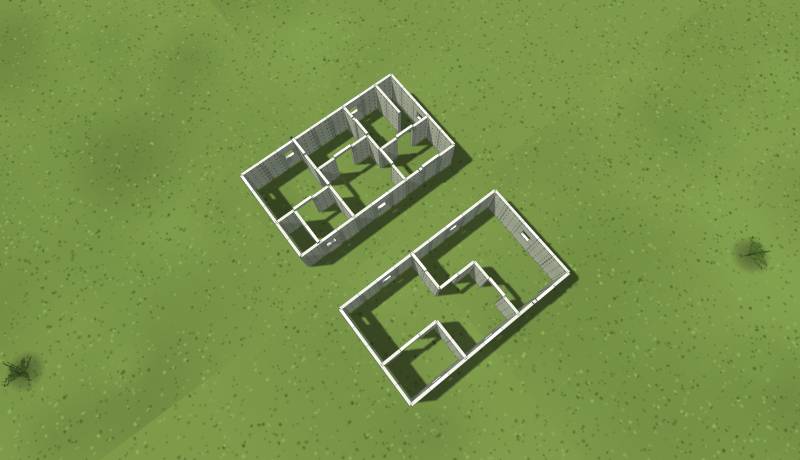
Take two layouts on the same floor area. One is an open hall with a single entry. The other is divided into four rooms joined by a hallway. The second needs several times more wall sections, plus a door or opening for each room and a connector at each junction. The footprint is the same; the component list and the price are not. This is why a price per square foot tells you very little.
Standard parts or custom manufacturing
A custom floor plan does not mean custom walls. Most layouts can be built from standard sections, connectors and doors. Design and production costs rise only when the plan calls for non-standard heights, lengths, finishes or special elements.
How wall material affects the price
The wall material decides where the shoot house can be used, which ammunition it can take and how often parts need replacing. A cheap wall that cannot take live fire, or that must be replaced after one season outdoors, costs more over its life than its purchase price suggests.
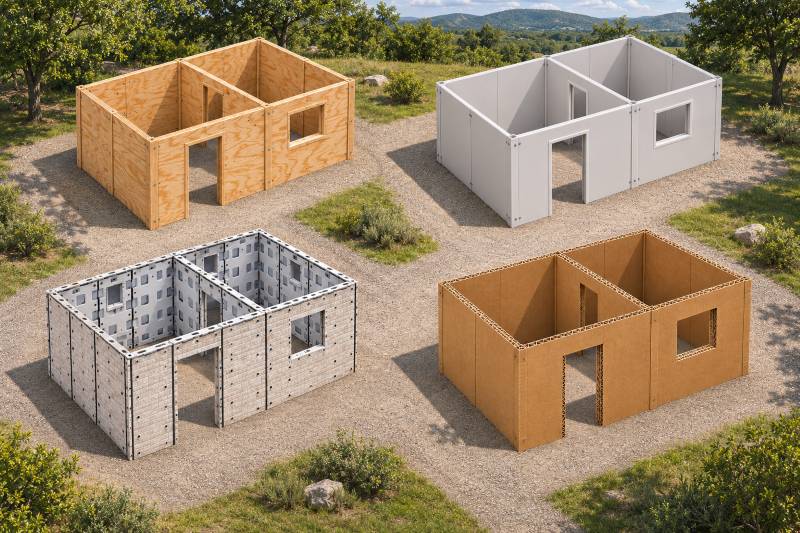
| Material | Live fire | Outdoor use | Ricochet risk | Cost over time |
|---|---|---|---|---|
| Corrugated cardboard | Depends on the product | Poor; moisture damages it | Low | Cheap to buy, replaced often |
| Plywood or OSB | Not suitable for most products | Only with outdoor-rated construction | Possible from fasteners and hardware | Heavy; joints and edges wear |
| PVC panels | Usually SIM only | Yes, with an outdoor grade | Depends on the product | UV and heat limits vary by grade |
| Steel with rubber facing (bullet-containing) | Yes; designed to stop rounds | Yes | Controlled by the rubber facing | Highest purchase price; heavy, usually a fixed installation |
| Panel-O-Foam™ (Trango) | Yes; rounds pass through | Yes | Ricochet-free, no hazardous fragments | Very durable, reusable; damaged parts replaced one by one. |
A Panel-O-Foam™ wall weighs about 27 lb (12 kg), light enough to carry by hand with no lifting equipment. The material sustains more than 12,000 hits with 5.56 mm and more than 6,000 with 9 mm. Read more about the composite and how it behaves under fire, or see a direct comparison of Panel-O-Foam™ and plywood.
Pass-through walls and bullet-containing walls are different products
This is the most common source of confusion when comparing prices. A pass-through wall lets the round continue through it without ricochet. It does not stop bullets, so the range still needs the backstop and safety area that its own live-fire rules require. A bullet-containing wall, usually steel with a rubber facing, stops the round inside the wall. It costs much more, weighs much more and is usually built as a fixed structure. Check which of the two a quote describes before comparing prices.
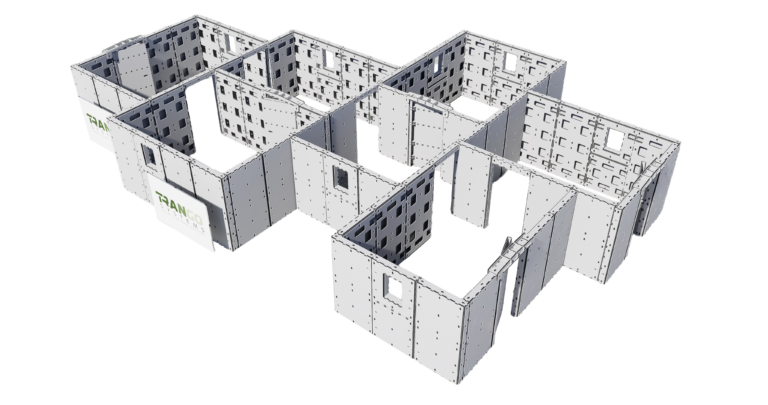
Modular shoot houses
One set of parts, many layouts
Interchangeable walls, doors and windows made of Panel-O-Foam™, for SIM and live fire, indoors or outdoors. Standard kits can be extended or rearranged into new layouts.
Total cost over the service life
The purchase price is only the first cost. Three things decide what the shoot house costs over the years:
- Replacement parts. In some systems a damaged facing, door leaf or connector can be replaced on its own. In others, the replacement is a complete wall module. Ask what the smallest replaceable part is and what it costs.
- Durability under your ammunition. A service-life figure means nothing without the conditions behind it: caliber, number of hits, how concentrated the hits are, and weather exposure.
- Reconfiguration. A layout that can be rearranged gives units new scenarios without buying a new structure. Check that the same parts work in other layouts, and which extra parts each layout needs.
For the design choices that lower long-term cost, see Shoot House Cost Considerations. For a comparison with permanent concrete or wood structures, see Trango shoot houses vs. traditional materials.
Checklist for comparing quotations
| Check | Question to ask |
|---|---|
| Included parts | Are complete walls, connectors and supports all listed? |
| Layout | Which floor plan does the price cover, and what is the usable area? |
| Wall specification | Material, dimensions and reinforcement? |
| Doors and windows | Openings or working assemblies? How many of each? |
| Ammunition | SIM only, or live fire? Which calibers? |
| Live-fire design | Pass-through or bullet-containing? |
| Outdoor use | Is the quoted version rated for outdoor use? |
| Other layouts | Which extra parts are needed for alternative layouts? |
| Expansion | Can single components be added, or only complete kits? |
| Spares | What is the smallest replaceable part, and its price? |
For wider buying criteria, see How to Choose a Shoot House. To score competing offers side by side, use the Shoot House Buyer Scoring Matrix.
What to send for an accurate quote
- A layout drawing or an estimated footprint, with the number of rooms
- Training ammunition: SIM, live fire, or both, and the calibers
- Indoor or outdoor use
- The number of working doors and windows, and their type
- Any alternative layouts the same parts must support
Frequently asked questions
-
How much does a modular shoot house cost?
Prices range from about $2,500 for a small cardboard layout to hundreds of thousands of dollars for a large reusable system. Trango Systems shoot houses start from approximately $20,000 for a two-room layout. The final price depends on the number of walls, working doors and windows, the wall material and the ammunition.
-
Can shoot house prices be compared by floor area?
Only when the layouts and specifications match. The same area can hold very different numbers of walls, doors and connectors.
-
Does a custom layout need custom-made walls?
No. Most custom layouts are built from standard modular parts. Special manufacturing is needed only for elements outside the standard range.
-
Do live-fire shoot house walls stop bullets?
Not all of them. Pass-through walls, such as Panel-O-Foam™, let rounds pass without ricochet but do not stop them. Bullet-containing walls stop rounds and cost much more.
-
How long do Panel-O-Foam™ walls last?
With live fire, a Panel-O-Foam™ wall sustains more than 12,000 hits with 5.56 mm and more than 6,000 with 9 mm. With SIM, it stops the rounds. These walls are weather-resistant and very durable. Clients report using the same walls for many years. Damaged parts can be replaced individually.