Selecting the Right Target for Every Range: Indoor vs Outdoor Best Practices
Training environment plays a big role in target selection. Indoor ranges and shoot houses have different constraints than outdoor shooting ranges.
Indoor Training
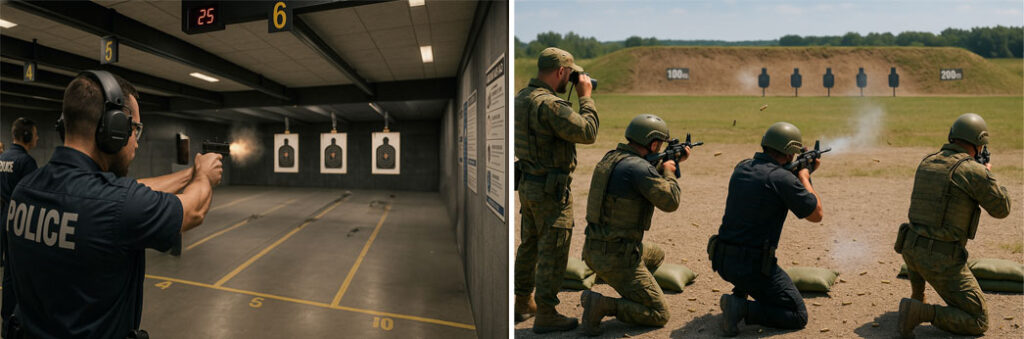
Most indoor police ranges are used for handgun and rifle drills at relatively short distances (5 to 25 yards). Ventilation and safety are key concerns – materials that minimize lead dust and ricochet are preferred. This is why indoor facilities often rely on paper or polymer targets with a proper bullet trap downrange. Using steel indoors is possible but requires bullet traps or frangible ammo to avoid ricochet in a confined space. Many indoor ranges use overhead or rail-mounted target carrier systems to send paper targets out and back. Lightweight paper or cardboard targets are ideal for these automated carriers. Also, indoor environments allow more control over lighting. Trainers can simulate low-light by dimming lights and using targets with visible markings (e.g. reflective or high-contrast features for flashlights). Target materials and design must handle close proximity. For CQB kill-houses (indoor mock buildings), targets will be engaged at just a few feet to a few meters. In those cases, ricochet-free targets (like cardboard, polymer, or composite targets) are a must for safety. Noise is another factor. Steel targets ringing in an enclosed space can be deafening, so many indoor exercises stick to quiet targets. Finally, flame retardance can matter. In live-fire shoot houses, stray muzzle blasts or burning fragments could ignite materials, so some specialized targets are treated to be fire-resistant. In summary, indoors favors targets that are safe at close range, low in debris, and easy to swap out or reset in tight quarters.
Outdoor Training
Outdoor ranges allow for greater distance and freedom of movement. Military shooting range targets often involve long-range rifle fire (100–300+ meters) and require durability against high-power rounds. Steel targets shine outdoors where space mitigates ricochet risk – for example, long-distance steel silhouettes for sniper or rifle qualification courses. Weather is a consideration: rain or wind can shred paper targets, so sturdier materials or weatherized paper (waxed or plastic-coated) might be used for extended outdoor use. Polymer/composite targets and steel targets are largely weatherproof; some advanced composite targets are weather and waterproof. This means they can be left in place on open ranges. Temperature extremes can affect target materials. Extreme cold can make rubber or polymer brittle. Extreme heat can soften or warp plastics. Metal targets can get very hot under sun or from repeated bullet impact, but generally remain functional. Outdoor environments also let you use larger targets (like vehicle targets or multiple target arrays) and moving target equipment that require space. For instance, a moving target on a rail line that simulates a running adversary, or a target that pops up from behind a berm. Or even the advanced moving targets controlled remotely and moving in any direction. Additionally, outdoor live-fire combat courses can integrate targets in buildings or hiding behind obstacles to practice tactical movement. In essence, outdoor use demands robust, weather-resistant targets and allows employing the full spectrum of target types, whereas indoor use imposes more safety and space limitations.
Trango Composite Targets – Built for Both Indoor & Outdoor Ranges
Trango’s advanced composite targets are ricochet-free, so instructors can run point-blank CQB drills inside a shoot-house without the standoff rules that steel demands. At the same time, the same panels withstand more than 12,000 hits of 5.56 mm or >3,000 hits of 9 mm. They are shrug off rain, UV and sub-zero temperatures, and remain stable in high wind. All these makes them equally at home on open-air rifle lines. They are lightweight and can be easily repositioned from one place to another. In short, one Trango target solution covers the full training envelope, slashing inventory and maintenance costs for range managers.