Types, Materials, and Shooting Scenario Considerations
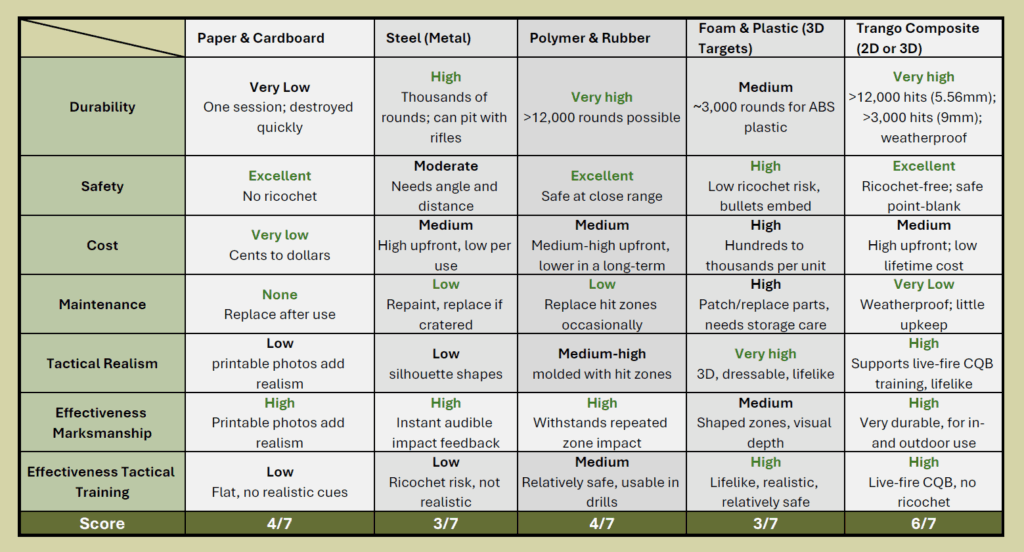
Police and military shooting instructors know that choosing the right targets can make or break a training program. Different shooting targets are used to build firearm proficiency, from basic marksmanship on the range to high-intensity CQB targets for room-clearing drills. This comprehensive guide breaks down the types of targets used in law enforcement and military training, compares materials (paper, steel, composite, polymer, etc.) for durability and safety, and explores how target design changes for indoor vs. outdoor and static vs. dynamic scenarios. We’ll also look at the latest durable shooting targets offering advanced features and realism, and consider special Close-Quarters Battle (CQB) requirements alongside traditional marksmanship needs. The goal is to give trainers and decision-makers a clear, practical overview of various options, so they can select the best shooting targets for any situation.
Types of Training Targets for Tactical Shooting
There is a wide array of target types available for military shooting range targets and police trainers. Each serves different training goals, from honing accuracy to simulating real threats. Below we break down the major categories of targets and their uses.
Shooting Targets by Material
Paper and Cardboard Targets
Paper targets (often mounted on cardboard backers) are the most basic and widely used. They include simple bullseye patterns for precision shooting and human-shaped silhouette targets for defensive shooting practice. Law enforcement qualifications frequently use paper silhouettes like the B-27 or similar designs with scoring zones, as these police training targets allow scoring hits easily.
Advantages
Paper targets are cheap, disposable, and great for recording shot groupings and scores. They work well for indoor ranges and controlled drills.
Drawbacks
They are one-time use. After a few hits, you typically replace them. They also offer no reaction or feedback besides holes, and provide only 2D imagery. Outdoors, paper can tear in wind or rain, and needs a sturdy stand or target carrier. Despite their limitations, paper targets remain a staple for basic firearm proficiency training due to cost-effectiveness and simplicity.
Steel Targets
Hardened steel targets (often AR500 or AR550 grade plates) are popular for military shooting range targets and tactical training where live-fire feedback is needed. Steel targets are typically shaped as circles or silhouettes and mounted on hinges or stands. When hit, they produce a loud clang and often fall or swing, giving immediate confirmation of a hit.
Advantages
Steel is extremely durable. A quality steel target can endure thousands of rounds over years. The audible and visual feedback (the sound and motion) makes training engaging and allows shooters to know instantly if they hit the mark. Steel targets are excellent for long-range rifle training and outdoor ranges; militaries use pop-up steel silhouettes for field firing exercises.
Drawbacks
Safety and environment are major considerations. Steel causes bullet fragmentation and ricochet hazards – shooters must maintain a safe distance and proper angle to avoid backsplash. In CQB or close pistol work, steel targets are generally not used because of ricochet risk. They also must be inspected for pitting. Steel is heavy and not easily moved for scenario changes. In indoor ranges, steel may be limited or require special bullet trap setups due to ventilation and ricochet concerns.
Polymer and Composite Targets
Polymer, rubber, and composite targets are modern solutions designed to combine the best of paper and steel while minimizing drawbacks. They allow durable shooting targets that handle thousands of rounds. For example, some advanced polymer silhouette targets look like a standard paper target but last far longer, being made of laminated recycled rubber instead of paper. High-end composite targets have incredibly long lifespans. For example, Trango Systems’ advanced polymer targets can absorb over 12,000 rounds of 5.56 mm or over 3,000 rounds with 9 mm before replacement. The weight of this type of targets differs depending on the shape (2D or 3D) or the base material.
Advantages
These targets are ricochet-free. Bullets pass through or get absorbed without fragmenting, making them safe for CQB and close-range use. They’re also weatherproof and can be used outdoors without damage from rain or sun. Many polymer and composite targets are multi-caliber, handling pistol and rifle rounds. They provide some reactive feedback too; for instance, a hit can create a visible splatter or swing a hanging polymer target.
There targets are very durable, sustaining thousands of rounds This make them extremely cost-effective over time.
Drawbacks
Initial cost is higher than single use cardboard or paper. However, their longevity can reduce long-term training costs by needing fewer replacements. Also, while more realistic than plain steel, basic polymer silhouettes might still be flat shapes unless designed with 3D features. Nonetheless, the balance of safety, durability, and versatility makes advanced composite targets increasingly popular for police and military training where high-volume shooting and close engagement are routine.
Shooting Targets by Type
Reactive Targets
Reactive targets provide immediate feedback upon impact, compelling shooters to adapt dynamically. These targets are integral in both law enforcement and military training environments, offering a range of systems that respond visibly or audibly when struck. Common examples include falling plates that collapse upon a successful hit and steel pepper-poppers that reset after being knocked down.
A more advanced category within reactive targets is the turning target system. These systems rotate to expose or conceal the target on a timer, making them particularly effective for judgmental shooting drills. They can swiftly alternate between displaying a threat or a “no-shoot” figure, challenging shooters to make rapid decisions under pressure. Instructors can remotely control these systems, integrating random exposure timing and friend-and-foe scenarios to add layers of stress and realism to training sessions. Such systems are great for law enforcement qualifications, where quick decision-making is paramount.
Advantages
Reactive targets provide immediate feedback, improving shooter response times and decision-making skills. The dynamic nature of these targets enhances target acquisition and transition under stress, fostering faster and more accurate shooting. Moreover, the ability to electronically control these systems allows for real-time scenario manipulation, tailoring training to specific needs.
Drawbacks
The inclusion of moving components in reactive targets increases the potential for wear and tear, necessitating more frequent maintenance. These systems can be costly and often require power sources or pneumatic systems, limiting their deployment to facilities with the necessary infrastructure. Installation can be complex, especially for turning systems, and they are typically confined to indoor facilities or established ranges equipped to support such equipment.
Moving Targets
Moving targets elevate training realism by simulating the unpredictable nature of real-world threats. These targets can traverse along tracks, emerge from cover, or be mounted on robotic bases capable of erratic motion. The most advanced systems feature remote-controlled mobile targets that can navigate various terrains and maneuver unpredictably.
A notable example is the LIAM Moving Target by Trango Systems. This modular solution combines a maneuverable base platform with interchangeable targets, compatible with both 2D and 3D models from Trango’s Range Targets and Friend & Foe series. The LIAM moving target system simulates real-world threats with dynamic movement in any direction, offering remote control precision and modular target options. It operates smoothly across diverse terrains, including uneven and rugged surfaces, and remains stable and responsive even in challenging environments. The system’s battery is in protective armor with ricochet protectors. This ensures durability and consistent performance in tough operational settings.
Advantages
Moving targets offer realistic combat simulation, mimicking unpredictable adversary behavior and sharpening tracking and motion-predictive shooting skills. They elevate engagement difficulty, pushing shooters beyond static range habits. The LIAM system, in particular, introduces dynamic, unpredictable movement into tactical exercises, strengthening decision-making, reaction times, and engagement accuracy under pressure. Its modular structure supports both 2D and 3D target models, allowing for seamless adjustments based on mission-specific training needs. The system is also designed with safety in mind, utilizing ricochet-free materials for maximum trainee protection.
Drawbacks
The complexity of moving target systems entails a higher initial investment and more frequent maintenance due to moving parts. They require ample space, especially outdoors, and robust safety protocols to ensure safe operation.
3D Mannequin Targets
Three-dimensional targets bring tactical realism to another level. These include life-sized mannequin figures made of foam, rubber, or plastic that can be shot with live ammunition or simulation rounds. Examples range from simple torso-shaped blocks to highly detailed humanoid dummies. Some 3D targets are anatomical, with vital organs or skeletal structures marked internally for medical training or more realistic feedback on shot placement. Others are plain torsos that can be dressed in clothing for scenario drills.
Advantages
3D targets present a lifelike shape and depth. Trainees can engage them from various angles – not just straight-on – which is critical in urban combat or room-clearing where targets may be partially behind cover or at oblique angles. They simulate real-life situations better than flat paper. Military and police units use 3D targets to acclimate shooters to engaging human-like figures and to practice proper threat discrimination under realistic conditions. These targets can be mounted on standard range lifters, placed in vehicles, or set in shoot houses for scenario training.
Drawbacks
3D targets are more expensive. They are also bulkier and heavier than paper or polymer targets. This makes changing training setting more complicated and time consuming. They often eventually break down (chunks of foam or plastic will tear off after many impacts), although many are designed to handle a high round count. They also lack the precise scoring of paper targets – they are for tactical realism, not marksmanship scores.
Shoot/No-Shoot Scenario Targets
One critical subset of targets for law enforcement and military combat training is the shoot/no-shoot target, sometimes called friend-and-foe targets. These are targets specifically designed to train threat discrimination and judgment under pressure. They often feature human images. Some armed (the “shoot” targets) and some innocents or fellow officers (the “no-shoot” targets). These can be paper photo targets, cardboard with prints, polymer or composite targets, or 3D mannequins holding props. The goal is to force split-second decision-making. The trainee must quickly observe whether the target is a threat before firing.
Importance: In real operations not every target is a bad guy. Incorporating shoot/no-shoot scenarios is essential for situational awareness training. It trains officers and soldiers to identify weapons or hostile intent under stress and avoid tragic mistakes. Using photo-realistic targets of bystanders, hostages, or enemy combatants mixed together builds the habit of assessing before shooting.
Key Features of advanced Shoot/No-Shoot Targets
Modern friend-and-foe targets are very realistic. High-resolution images of people in various poses and clothing. The best designs include subtle cues (for instance, one target might show a person holding a firearm at their side vs. another holding a cellphone) so that trainees must truly look and not rely on obvious indicators. These targets heighten psychological immersion and stress in training.
When done right, scenario targets dramatically improve an officer’s reaction time and threat recognition skills. They add practical judgment training on top of marksmanship. Many agencies now use them in active shooter drills, simulation training, and qualifications to ensure decision-making under pressure is practiced, not just pure shooting skills.


Indoor vs. Outdoor Deployment
Indoor Ranges & Shoot Houses
Space is tight. Ricochet tolerance is zero. Therefore, trainers favor targets that stay intact at muzzle distance and shed no fragments. Paper works for basic drills, but advanced-composite silhouettes excel. They are safe on contact, low dust, and fast to reset, keeping ventilation systems cleaner and throughput high.
Outdoor Live-Fire Courses
Distance and weather set the rules. Hardened steel plates still dominate long-range rifle stages for their audible feedback, while advanced composite targets bridge the gap: they shrug off UV, rain, and cold, yet remain ricochet-free for close-in CQB lanes arranged on the same range. The result is one rugged target family covering everything from 5-yard pistol snapshots to 300-meter carbine engagements.
For a deep-dive on range configuration, see Selecting the Right Target for Every Range: Indoor vs Outdoor Best Practices.
Static vs Dynamic Training Scenarios
Static targets are those that stand in place, continuously visible, until the shooter engages them. Dynamic targets either move, appear/disappear, or otherwise change during the drill. Both have roles in training:
Static Target Training
Static targets are valuable for building fundamental skills. New shooters learn on static bullseyes to master basics of aim, trigger control, and grouping. Police qualification courses often involve static silhouette targets at known distances – testing marksmanship and speed in a controlled setup. Static targets also allow focused drills on specific techniques (e.g. drawing and firing, or practicing specific shot placement). However, static targets alone do not induce much stress or realism beyond marksmanship. In real encounters, threats won’t stand still in the open indefinitely.
Dynamic Target Training
Introducing movement or time pressure with targets greatly increases training effectiveness for combat scenarios. For example, moving targets teach a shooter how to lead a target and handle moving threats. Likewise, targets that turn or pop-up force a split-second response. A turning target system might show a blank edge (non-threatening) then suddenly turn full face (threat target) for only a second or two – the shooter must decide to shoot or not within that window. This builds the ability to make quick judgments under pressure. Incorporating these critical decision-making elements is strongly recommended by training experts. Dynamic scenarios also include shoot/no-shoot or friend-and-foe target presentations.
A combination of static and dynamic training is best. Static targets are used for honing accuracy and technique; dynamic targets are used for testing and applying those skills under realistic conditions.
To Sum Up
Choosing the right shooting targets is far more than a matter of budget or availability. It’s a strategic decision that directly impacts training outcomes. Whether the goal is precision marksmanship, reflexive shooting under pressure, or realistic scenario-based engagement, the choice of targets should align with specific training objectives. In today’s rapidly changing security landscape, the quality and capability of your targets can define the readiness of your personnel.